

A landmark census has revealed encouraging signs for the endangered Marsican brown bear. As this iconic subspecies expands beyond its historic stronghold in Italy’s Central Apennines, connected, bear-smart landscapes will be key to its long-term recovery.

Making space for Europe’s rarest bear 
Found nowhere else on Earth, the Marsican brown bear is one of Europe’s most endangered large mammals. With only a small population surviving in Italy’s Central Apennine mountains, every bear matters. While decades of conservation have helped prevent extinction, the long-term future of the subspecies depends on more than protecting its historic stronghold.
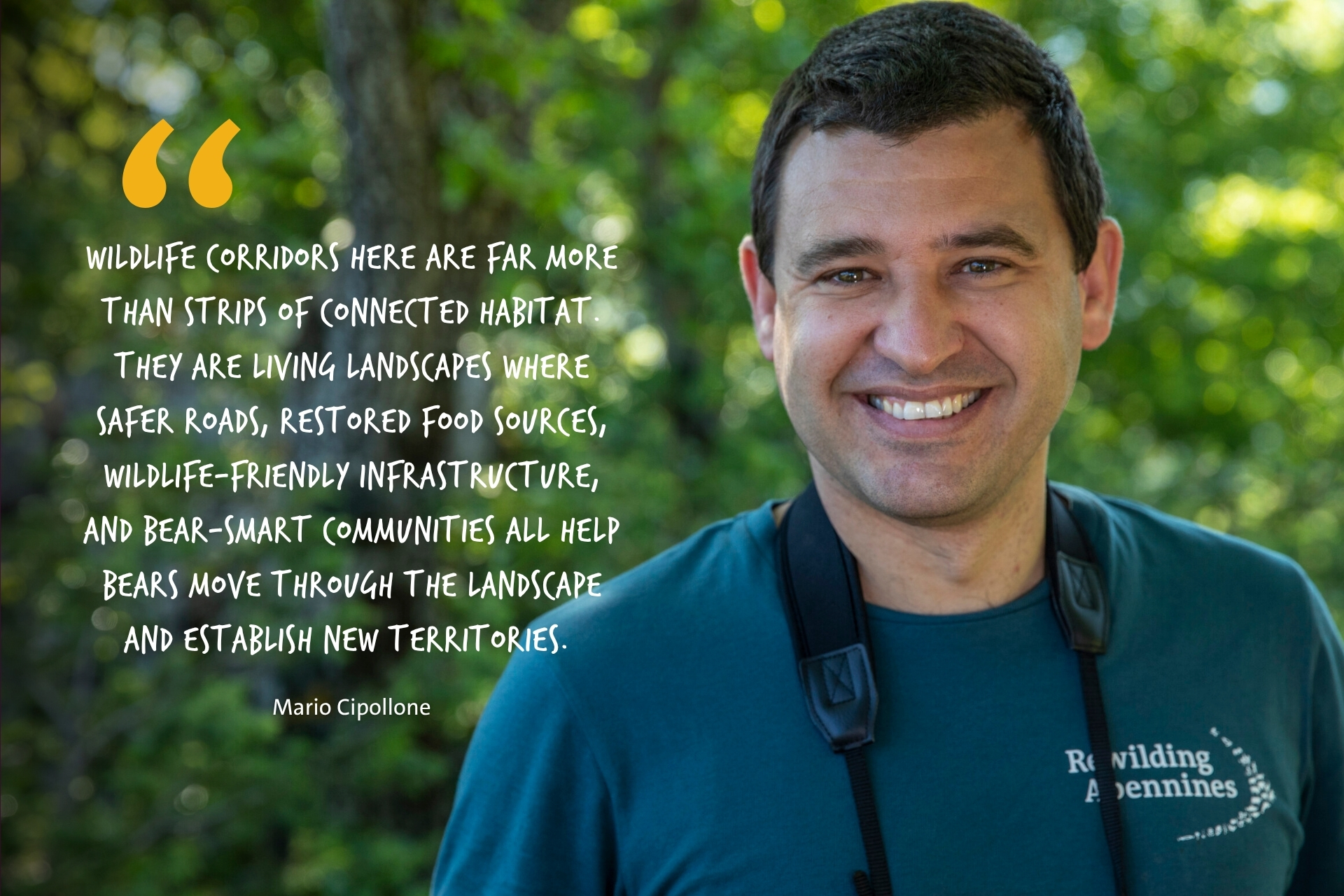
This is where Rewilding Apennines is focusing its efforts. Working with local partners through the EU-funded LIFE Bear-Smart Corridors initiative, the team are reconnecting the landscape beyond protected areas, enabling bears and other wildlife to move more safely and freely. Along strategic large-scale corridors, practical measures such as electric fencing, bear-proof waste bins, orchard restoration, community outreach, and enterprise support are helping people and bears thrive together.
This approach recognises a simple reality: for the Marsican brown bear to recover, individuals moving into new areas need more than suitable habitat — they need landscapes where they can find food, disperse naturally, and live alongside communities that want to share their surroundings with them. By creating such “bear-smart” landscapes, the Rewilding Apennines team are helping lay the foundations for the long-term comeback of this iconic subspecies.


A landmark census
The importance of this work has now been reinforced by the most comprehensive survey ever undertaken of the Marsican brown bear population. Carried out during 2025 as part of Italy’s DigitAP project, the census covered around 6,000 square kilometres across the bear’s entire known range. Using non-invasive sampling, researchers from ISPRA and the Charles Darwin department of Sapienza University analysed 854 hair samples and genetically identified 70 individual bears.
Overall, the study estimates that around 81 Marsican brown bears now live across the Central Apennines, encompassing 43 females and 38 males. Within the historic core area centred on the Abruzzo, Lazio and Molise National Park, the population has remained stable — or increased slightly — over the past decade, with an estimated 56 bears now living here. When neighbouring areas that have recently been colonised — including Valle Roveto and the Monte Genzana Alto Gizio Reserve — are included, this figure rises to 65 bears, showing that these landscapes are now home to a single, continuous population. The remaining 16 bears within the estimated population live in areas further from this central stronghold. These findings offer cautious optimism. They show that the population is stable in its historic heartland and beginning to expand into neighbouring landscapes. The next challenge is ensuring that this expansion can continue, allowing bears to establish viable populations beyond the limits of the protected core.

Connectivity and coexistence are critical
One of the census’s most important findings was not simply how many bears were counted, but what determines where they occur. Researchers found that habitat quality alone does not explain the low numbers in peripheral areas. Instead, bear density declines with distance from the historic core, showing that expansion is still at an early stage. Crucially, areas connected to the core through suitable habitat corridors support significantly more bears than equally distant but less connected landscapes.
The study also found that areas with higher levels of human-caused mortality — such as road collisions, poisoning, and poaching — support fewer bears. While the historic core holds around 4.4 bears per 100 square kilometres, peripheral areas support only around 0.4 bears per 100 square kilometres — roughly ten times less. Researchers conclude that these landscapes could support many more bears if connectivity improves and human-caused mortality is reduced.
These findings support the approach taken by Rewilding Apennines.
A future beyond the core
For the first time, conservationists have a clear picture of the Marsican brown bear population across its entire range. Census results confirm that the historic population remains stable, while also revealing the first encouraging signs that bears are expanding into neighbouring landscapes.
At the same time, the study also highlights how much work remains. Just 16 bears currently occupy the more peripheral parts of the range, which is too few to represent a secure population. Whether this number grows will depend on protecting and restoring the corridors that connect suitable habitat, reducing human-caused mortality, and continuing efforts to help people and bears share space.
This is exactly the vision driving Rewilding Apennines. By creating connected, bear-smart landscapes where wildlife and people can thrive together, the team are helping one of Europe’s rarest large carnivores move beyond its historic stronghold, reclaim more of its ancestral range, and become an even stronger symbol of a wilder, more resilient Central Apennines. The lessons being learned here could also help shape the recovery of bear populations elsewhere in Europe, demonstrating the power of enhancing ecological connectivity and human-wildlife coexistence in the same landscapes.
Invaluable support
Rewilding Europe’s work in our rewilding landscapes is supported by a wide range of highly valued partners. We would like to thank all our financial partners, in particular those providing core funding – notably the European Union’s LIFE programme, the Dutch Postcode Lottery, Ecological Restoration Fund, Endangered Landscapes & Seascapes Programme, Cartier for Nature, Oak Foundation, EnviroSustain, WWF-Netherlands, and Arcadia. Their longstanding support plays a critical role in enabling us to deliver and scale up rewilding impact.
